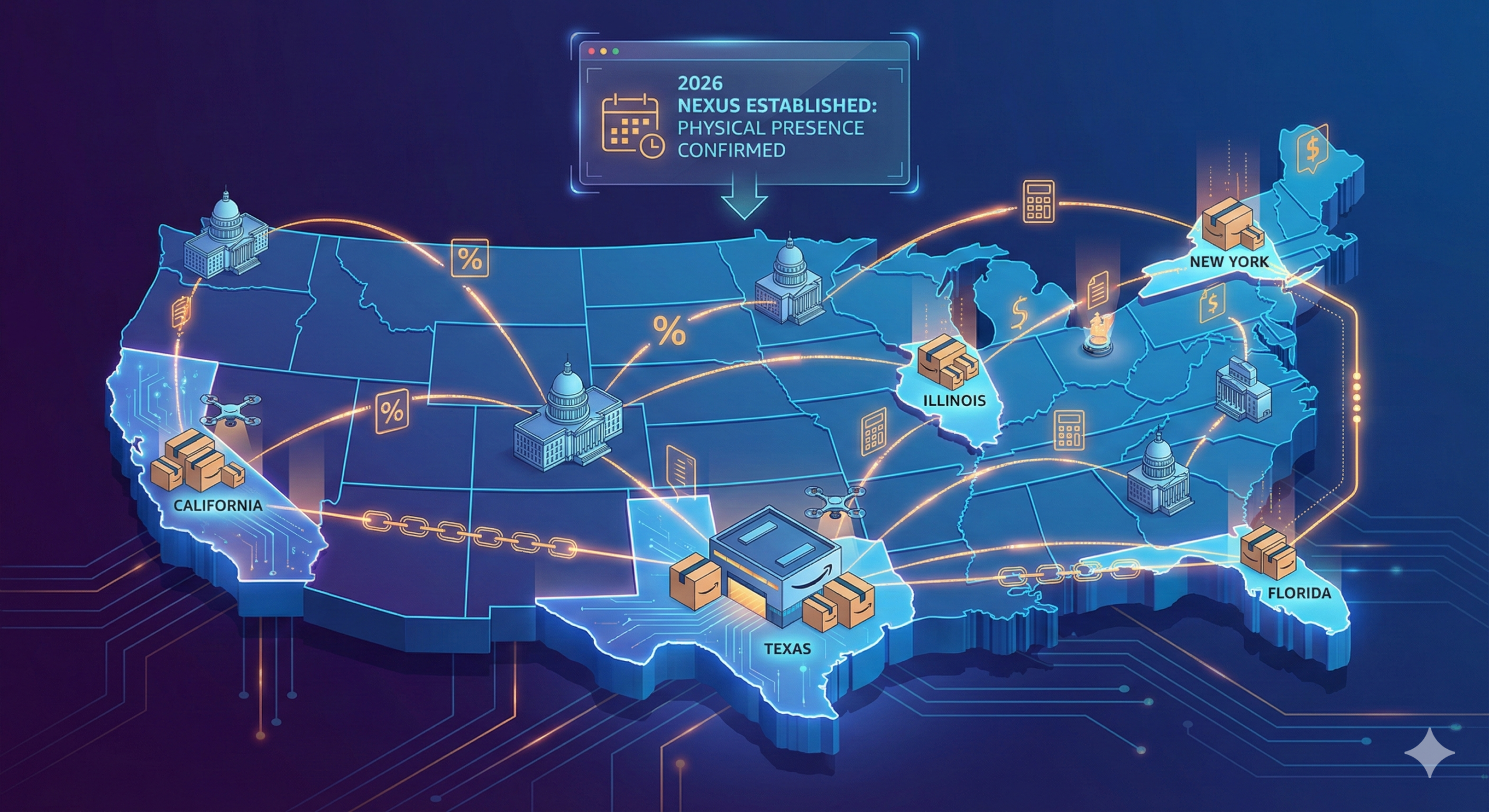
You send your inventory to Amazon, and you feel relieved. Amazon handles the shipping, the customer service, and thanks to Marketplace Facilitator Laws, they even handle the sales tax collection for most states.
So, you can just sit back and relax, right?
Wrong.
There is a legal loophole that aggressive states like California and Washington are using to audit thousands of unsuspecting sellers. It’s called the “Inventory Trap.” This creates a complex Amazon FBA sales tax nexus issue that traps thousands of sellers.
Even if you live in Florida, if Amazon moves just one unit of your product to a warehouse in California, the state of California may consider you a “local business” with full tax obligations.
Here is the definitive guide to Amazon FBA Inventory Nexus in 2026, explaining why “Physical Presence” isn’t what you think it is, and how to protect your business without going bankrupt.
The Two Types of Amazon FBA Sales Tax Nexus
To understand why you might owe taxes in a state you’ve never visited, you need to understand “Nexus.” Nexus is just a fancy legal word for “sufficient connection.” If you have nexus, the state has the power to tax you.
1. Economic Nexus (The “Wayfair” Rule)
This is the famous one. Since 2018 (South Dakota v. Wayfair), states can tax you if you sell enough money there.
- The Threshold: Usually $100,000 in sales or 200 transactions.
- The Trend: Good news here. For 2026, states like Illinois are joining others in removing the 200 transaction threshold. They only care about the dollar amount now.
2. Physical Nexus (The “FBA” Trap)
This is where the nightmare begins. Traditionally, “Physical Nexus” meant you had an office or an employee in the state. But for FBA sellers, states argue that owning inventory sitting on a shelf in their state constitutes a “physical presence.”
- The Reality: Amazon distributes your inventory to dozens of Fulfillment Centers (FCs) across the country to speed up Prime delivery. You don’t control this.
- The Consequence: You might inadvertently trigger Physical Nexus in 20+ states without making a single direct sale.
The “Inventory Trap”: Why States Are Aggressive
You might be thinking: “But Amazon collects the tax for me! Why does the state care?”
States care because they want visibility. They want you registered in their system. Even if Amazon pays the sales tax, many states demand that you:
- Register for a Sales Tax Permit.
- File a “Zero Return” (showing $0 tax due from you, but reporting the gross sales).
If you don’t file these “Zero Returns,” aggressive states like California or Washington can audit you. They might even try to claim you owe Income Tax or Franchise Tax (like the $800/year LLC fee in California) just because your inventory “lived” there.
The “Diet Standards LLC” Precedent (2025)
This is a critical update. In 2025, a California ruling (Diet Standards LLC) confirmed that even a de minimis amount of inventory (less than $2,500 worth) was enough to trigger nexus.
- The Lesson: There is no “safe minimum.” If your stuff is there, you are there.
The “Hit List”: States to Watch in 2026
Not all states are equal. Some are lenient, and some have dedicated task forces hunting FBA sellers.
| Risk Level | Key States | enforcement Style |
|---|---|---|
| 🔴 AGGRESSIVE | California, Washington, Illinois, Massachusetts, Maine | Strict enforcement. They use “Inventory Nexus” to demand back taxes. California is the most dangerous. |
| 🟡 MODERATE | Texas, Florida, Pennsylvania | High volume states. Texas has a higher threshold ($500k), making it safer for smaller sellers. |
| 🟢 LENIENT | Missouri, Alabama, Mississippi | Generally follow standard economic thresholds. Less likely to audit small FBA sellers solely for inventory. |
How to Track Your Inventory Nexus (The Tool)
Stop guessing. Amazon provides a report that acts like a “bank statement” for your inventory.
The Report: FBA Inventory Ledger. (Formerly known as the Inventory Event Detail report).
How to use it:
- Go to Seller Central > Reports > Fulfillment.
- Download the FBA Inventory Ledger (Detail View).
- Filter by “Receipts” (when inventory arrived) and “Shipments.”
- Create a Pivot Table to group by State.
This will show you exactly where your products are sitting right now. If you see significant stock in Pennsylvania, you likely have Physical Nexus in Pennsylvania.
The Strategy: “Strict” vs. “Practical” Compliance
So, do you register in all 25 states where Amazon sent your units? Most experts suggest a Risk-Based Approach.
Option A: The “Strict Legal” Approach 🛡️
- Action: Register in every single state where you have inventory.
- Pros: 100% audit-proof.
- Cons: Administrative nightmare. You will be filing 30+ returns a month. Expensive software fees (TaxJar/Avalara) are mandatory.
Option B: The “Practical” Approach (Recommended for Small Sellers) ⚖️
Register ONLY in states where:
- You live/work (Home State).
- You have hit the Economic Nexus threshold ($100k sales).
- You have significant inventory in an Aggressive State (like California).
Why? The cost of compliance (software + time) often outweighs the risk for small sellers in lenient states. However, never ignore your Home State or California.
Summary: Your 2026 Action Plan
- Check the Ledger: Download your FBA Inventory Ledger monthly.
- Watch the $100k: Monitor your sales in each state. If you cross $100k, register immediately.
- Beware of California: If you have inventory there, consult a CPA. The $800 franchise tax risk is real.
- File Zero Returns: If you register, you MUST file. Never skip a filing just because “Amazon paid it.”
Understanding your Amazon FBA sales tax nexus is just one piece of the puzzle. Make sure you are also maximizing your deductions with our Amazon FBA Tax Deductions Checklist and understand the new 2026 1099-K Reporting Limits.